

 feedom@haomei-machinery.com
Big Concrete Pumps
Posted On: 14/07/2026 | Posted by: Haomei Concrete Pumps
Large placements can quickly expose the limits of undersized pumping equipment. A truck-mounted unit with insufficient reach may require extra pipeline, repeated repositioning, or a separate placing boom. An oversized machine can create access, outrigger, transport, and utilization problems.
Big concrete pumps are generally considered on projects where reach, placement speed, and reduced pipe handling justify the higher capital and mobilization cost. Typical applications include high-rise cores, large slabs, bridges, industrial foundations, dams, and major infrastructure works.
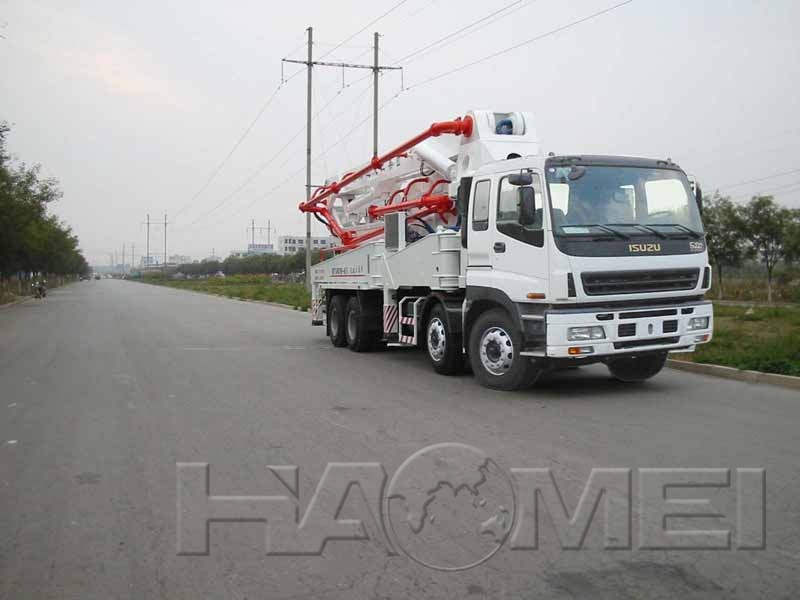
Match Reach and Output to the Actual Pour
Do not select a pump only by boom length. The published vertical reach is measured under defined boom geometry and does not equal usable reach on every site. Buildings, power lines, forms, retaining walls, and the required boom clearance can reduce workable coverage.
Start with a site drawing and mark every proposed truck position. Then confirm the needed boom tip location, hose length, outrigger footprint, and truck access route.
Use this selection checklist:
- Calculate the farthest and highest placement point from each possible setup position.
- Allow for boom articulation, obstructions, hose length, and safe working clearance.
- Compare the manufacturer's stated horizontal reach, vertical reach, and depth reach.
- Check the maximum outrigger spread for both full and restricted setups.
- Confirm axle loads, gross vehicle dimensions, road permits, and turning access.
- Match pump output and pressure to the mix design, pipeline layout, and planned placing rate.
A larger boom does not automatically deliver higher productive output. Theoretical output is a machine rating. Actual output can be limited by concrete supply, truck turnaround time, aggregate grading, pipe diameter, line length, elevation, valve wear, and crew coordination.
| Project condition | Practical equipment focus | Common selection risk |
|---|---|---|
| High-rise core or tower podium | Long vertical reach, pressure capability, stable setup area | Assuming rated boom reach equals clear site reach |
| Wide slab or warehouse floor | Horizontal coverage, fast truck cycling, fewer relocations | Choosing high output when batch supply cannot sustain it |
| Bridge deck or constrained roadwork | Compact setup geometry, traffic control, access planning | Ignoring outrigger space and lane closures |
| Remote infrastructure placement | Service support, parts availability, fuel logistics | Selecting a complex model without local technician coverage |
For work requiring a long reach over obstacles, assess a 65 Meter Concrete Pump Long Boom against the site plan rather than treating boom length as a standalone specification. A 65 m class machine can reduce relocations, but it requires a substantially larger setup envelope and rigorous ground assessment.
Confirm Pumpability, Ground Capacity, and Safe Setup
Concrete pumping is a system, not only a truck specification. The mix must be pumpable through the intended pipeline at the planned rate. ACI 304.2R, Placing Concrete by Pumping Methods, remains an important technical reference for evaluating materials, pipeline arrangements, and pumping practices. ASTM C94/C94M addresses ready-mixed concrete requirements, but compliance with that specification alone does not guarantee pumpability.
Before the pour, obtain written confirmation between the concrete producer, pumping contractor, and placing team on aggregate size, slump or slump flow, admixtures, target delivery rate, and discharge sequence. Trial pumping may be justified for difficult mixtures, long lines, lightweight aggregate concrete, or high-strength mixes.
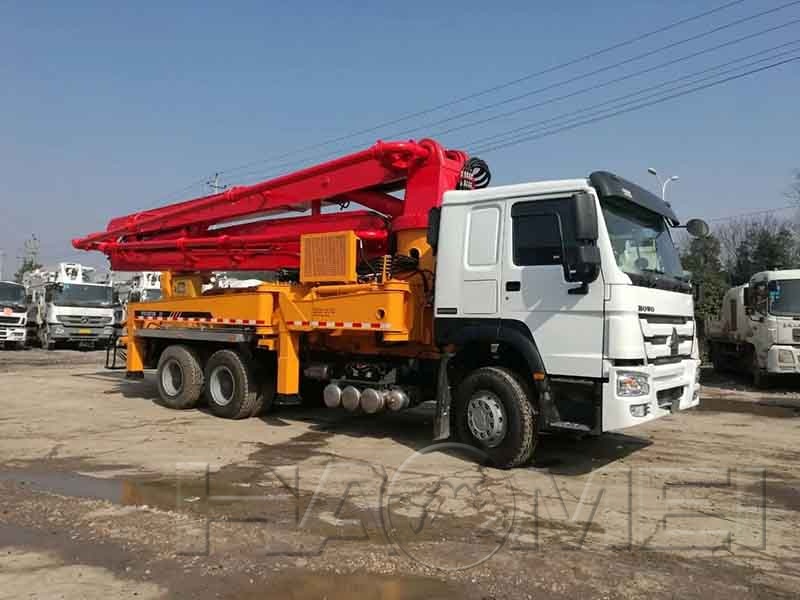
Outrigger loading deserves equal attention. The pump manufacturer provides outrigger reactions or ground-bearing data for each setup mode. The project engineer or competent geotechnical authority should determine whether the supporting surface can safely carry those loads. Timber, steel, or engineered outrigger mats spread loads, but they do not correct weak, voided, frozen, excavated, or poorly compacted ground.
Use a documented pre-pour inspection:
- Verify the setup surface, slope limits, mats, and outrigger deployment against the manufacturer manual.
- Establish exclusion zones around outriggers, boom movement areas, pipeline connections, and the end hose.
- Inspect delivery pipes, couplings, clamps, gaskets, boom sections, and hydraulic hoses for damage or excessive wear.
- Confirm radio communication between the operator, hose handler, concrete supplier, and site supervisor.
- Check overhead hazards and maintain required electrical clearances under applicable local rules.
- Never disconnect a pressurized line. Stop the pump, relieve pressure using the approved procedure, and secure the area first.
ASME B30.27 covers material placement systems and provides recognized safety expectations for inspection, operation, maintenance, and operator responsibilities. Local occupational safety rules, road regulations, and manufacturer instructions remain controlling where they are more stringent.
Evaluate Investment, Support, and Equipment Trends
Capital cost should be assessed as lifecycle cost per productive cubic meter, not as the purchase price alone. Request comparable quotations with the same chassis specification, boom length, pump cell configuration, warranty, commissioning scope, telematics subscription, and included accessories.
| Cost area | What to verify before purchase |
|---|---|
| Acquisition | Boom class, chassis emissions specification, options, delivery terms, financing conditions |
| Operating cost | Fuel use, wear parts, hydraulic oil, tires, insurance, transport permits |
| Maintenance | Cylinder, wear plate, cutting ring, pipeline, boom inspection, service labor |
| Downtime exposure | Local dealer response time, parts stock, backup equipment availability |
| Resale value | Brand support, service history, chassis condition, boom inspection records |
A machine with lower upfront cost can become expensive if parts availability is weak or pump wear causes repeated downtime. Ask suppliers for the recommended inspection intervals, expected consumables, maintenance labor assumptions, and records available from comparable fleet units.
For contractors working mainly on mid-rise structures and large commercial slabs, a 42m Concrete Pump Truck may provide better annual utilization than a very long boom model. The right choice depends on how often the added reach avoids relocation, additional pipeline, labor, or a second placement method.
Digital fleet tools are becoming more relevant in pump procurement. Telematics can record engine hours, location, diagnostic codes, fuel use, maintenance intervals, and operating events. Require clarity on data ownership, subscription renewal costs, cellular coverage, export capability, and whether fault alerts are available to both the owner and service provider.
Emission compliance must also be checked at the chassis level. In the United States, nonroad diesel engine requirements are administered by the U.S. Environmental Protection Agency. In the European Union, nonroad mobile machinery engine requirements are set under Regulation (EU) 2016/1628. Confirm the engine label and local registration requirements before importing or transferring equipment between regions.
A procurement package should include the manufacturer data sheet, load and outrigger information, service network contacts, warranty terms, parts pricing schedule, operator training plan, inspection records for used equipment, and a site-specific mobilization plan for the first pour.
Original source: https://www.concrete-pump-cn.com/a/big-concrete-pumps.html
Tags: Big Concrete Pumps, Concrete Boom Pump,
Previous: Portable Concrete Mixer and Pump
Next: