

 feedom@haomei-machinery.com
Z Boom Concrete Pump
Posted On: 20/05/2026 | Posted by: Haomei Concrete Pumps
A Z boom concrete pump is often chosen when the jobsite is tight, the pour point is behind columns, or the operator must unfold under height restrictions. The boom folds in a Z pattern, so it can open section by section and place concrete with less overhead clearance than many roll-fold designs.
For equipment purchasers, the main risk is not choosing too small or too large a machine. An undersized unit slows the pour and increases labor cost. An oversized unit raises capital cost, axle-load issues, fuel use, and setup time. Use the following process to match reach, output, chassis, compliance, and resale value before signing a purchase order.
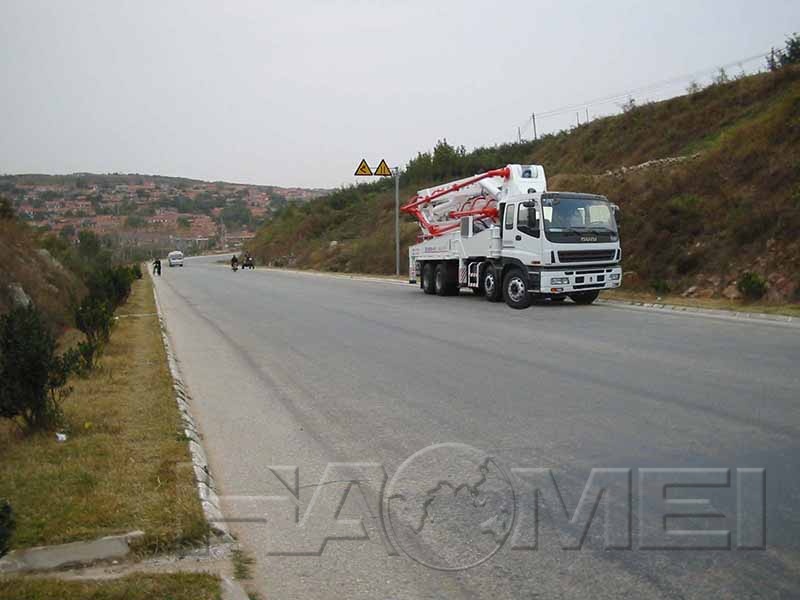
How a Z-Fold Boom Solves Jobsite Access Problems
Manufacturers use several boom layouts, including Z-fold, roll-fold, RZ, and multi-Z arrangements. A Z-fold concrete pump is designed to unfold in confined areas and work well around walls, slabs, tunnels, bridge decks, industrial foundations, and urban sites.
Do not select only by vertical reach. Confirm horizontal reach, unfolding height, outrigger footprint, pipeline diameter, concrete mix compatibility, and actual pump output at the slump and aggregate size used on your projects.
| Site problem | Why a Z-fold boom helps | Specification to verify |
|---|---|---|
| Low overhead obstruction | Sections can open progressively | Minimum unfolding height from OEM chart |
| Pour behind a wall or column | Articulated sections improve placement angle | Horizontal reach and end-hose working zone |
| Urban road restriction | Mid-size machines can reduce setup impact | Chassis length, axle load, outrigger spread |
| Frequent small pours | Fast setup can improve utilization | Setup time, washout process, fuel rate |
| High-rise or long-distance pumping | Boom alone may not be enough | Pump cell pressure and pipeline plan |
A practical reach rule is to map the pump location, not just the pour location. Allow space for outriggers, concrete mixer access, washout, traffic control, and exclusion zones. If the pump cannot be positioned safely, rated boom length has little value.
For mid-rise commercial work, a 45 Meter Z Boom Concrete Pump can be a balanced option when the contractor needs urban reach without moving into the cost and permitting burden of very long-boom equipment.
Selection Checklist and Cost Comparison
Start with production needs. Concrete pump output is usually published in cubic meters per hour or cubic yards per hour, but the site will rarely achieve the maximum rating. Output depends on mix design, line length, vertical rise, hose diameter, reducer use, wear condition, operator skill, and concrete supply continuity.
Use this purchase checklist before comparing offers:
- Confirm required vertical reach, horizontal reach, and minimum unfolding height.
- Check outrigger footprint against typical streets, slabs, and access roads.
- Match pump pressure and cylinder size to your mix designs and line lengths.
- Verify hopper height with your ready-mix truck fleet.
- Review chassis brand support, emissions level, axle ratings, and registration rules.
- Request wear-part prices for cutting rings, wear plates, delivery cylinders, elbows, seals, and clamps.
- Inspect boom welds, pins, bushings, slewing ring condition, hydraulic cylinders, and remote-control system.
- Ask for boom inspection records, pump hours, PTO hours, accident history, and maintenance logs.
- Confirm whether the sale includes reducers, hoses, pipe racks, washout accessories, and spare parts.
| Boom class | Typical application | Main advantage | Cost caution |
|---|---|---|---|
| 20 m to 32 m | Residential slabs, small commercial pours | Lower purchase cost and easier access | Limited reach may require repositioning |
| 36 m to 42 m | General commercial, warehouses, podium slabs | Strong utilization across many jobs | Check axle limits and outrigger space |
| 45 m to 52 m | Mid-rise, bridges, larger pours | Higher reach and fewer moves | Higher maintenance, insurance, and fuel cost |
| 56 m and above | Large infrastructure and high-output work | Long reach and premium rental potential | Expensive transport, permits, and setup planning |
Public market pricing changes with interest rates, emissions rules, machine age, brand, and local demand. As a budgeting screen, dealer listings and auction results from major marketplaces such as MachineryTrader and Ritchie Bros. commonly show used truck-mounted concrete pumps from under $150,000 for older small machines to well above $500,000 for late-model long-boom units. New long-boom machines can exceed $1 million depending on brand, chassis, boom length, and options. Treat these ranges as a planning filter only, and verify with written quotations, inspection reports, and recent local transaction data.
| Cost item | What to request | Why it matters |
|---|---|---|
| Purchase price | Written quote with chassis and pump specification | Prevents comparing different machine classes |
| Financing | Interest rate, term, down payment, residual assumption | Determines real monthly burden |
| Wear parts | 12-month expected parts package | High-wear concrete components affect margin |
| Compliance | Inspection, certification, emissions documents | Avoids downtime after delivery |
| Transport | Route permits, port fees, inland hauling | Large units can create hidden cost |
| Resale | Brand support and service records | Strong documentation protects asset value |
If your work is mostly 4-story to 8-story structures, compare reach drawings for a 42m Concrete Pump Truck against a 45 m class machine. The smaller unit may finish the same pours with lower ownership cost if setup locations are favorable.
Safe Operation, Maintenance, and Market Direction
A boom pump is a material placing system, not a lifting crane. In the United States, ASME B30.27 is the recognized consensus standard for material placement systems. OSHA requirements also apply to construction activities, including 29 CFR 1926.702 for concrete and masonry construction. In Europe, EN 12001 addresses safety requirements for concrete conveying machines. Local laws, inspection intervals, road rules, and operator qualification requirements must be checked before deployment.
Pre-pour safety steps should be written, assigned, and documented:
- Inspect ground bearing capacity before outrigger deployment.
- Use outrigger pads sized for soil and slab conditions.
- Maintain safe distance from excavations, slopes, trenches, and utilities.
- Establish a hose-handling exclusion zone, especially during priming and blockage clearing.
- Never stand in front of a pressurized end hose.
- Verify communication between pump operator, hose crew, mixer drivers, and site supervisor.
- Keep the boom clear of energized power lines according to applicable local electrical safety rules.
- Stop pumping before opening clamps or removing reducers.
Maintenance is where many ownership models fail. A concrete pump is exposed to abrasive slurry, high hydraulic pressure, vibration, and washout chemicals. Track wear by hours and pumped volume, not calendar time alone. Measure pipe wall thickness, inspect elbows, record hydraulic oil condition, and replace boom pins and bushings before looseness damages the structure.
A disciplined daily routine should include hopper grate function, emergency stop test, remote-control test, lubrication, water box inspection, hydraulic leak check, delivery pipe wear check, clamp and gasket inspection, and post-pour cleaning. For used equipment, a third-party boom inspection can uncover repairs, fatigue cracks, or undocumented structural damage.
Market direction favors efficient, data-enabled equipment. Telematics is becoming common for utilization tracking, fault codes, fuel consumption, maintenance alerts, and location monitoring. Fleet managers are also watching emissions compliance more closely, especially in urban projects where low-emission zones and public procurement rules can influence equipment acceptance.
Rental demand remains strong for versatile mid-size machines because many contractors do not pour enough volume to justify ownership. Purchase makes stronger financial sense when annual utilization is predictable, operators are trained, service support is nearby, and the machine can be scheduled across multiple project types.
Before purchase approval, require a live function test with water or concrete when possible. Confirm boom smoothness, pump stroke changeover, hydraulic temperature stability, remote response, hopper agitation, slewing performance, emergency stop function, and washout condition. Acceptance should be based on measured performance, documented inspection, and a realistic ownership cost model rather than boom length alone.
Original source: https://www.concrete-pump-cn.com/a/z-boom-concrete-pump.html
Tags: Z boom concrete pump, Z-fold boom pump, concrete pump truck, truck-mounted concrete pump,
Previous: Concrete Line Pump for Sale
Next: Concrete Pump Truck Price New