

 feedom@haomei-machinery.com
39m Concrete Pump
Posted On: 09/10/2026 | Posted by: Haomei Concrete Pumps
A 39m concrete pump truck is often a practical size for residential towers, commercial slabs, warehouses, bridges, and mid-rise structures where a line pump is too slow but a 47m-class machine adds unnecessary transport and setup cost.
The stated boom length is not a guarantee that every pour point is reachable. Truck location, outrigger spread, boom articulation, hose length, obstructions, and the required safe clearance all affect usable placement area. Select the machine from a verified manufacturer reach diagram, not boom length alone.
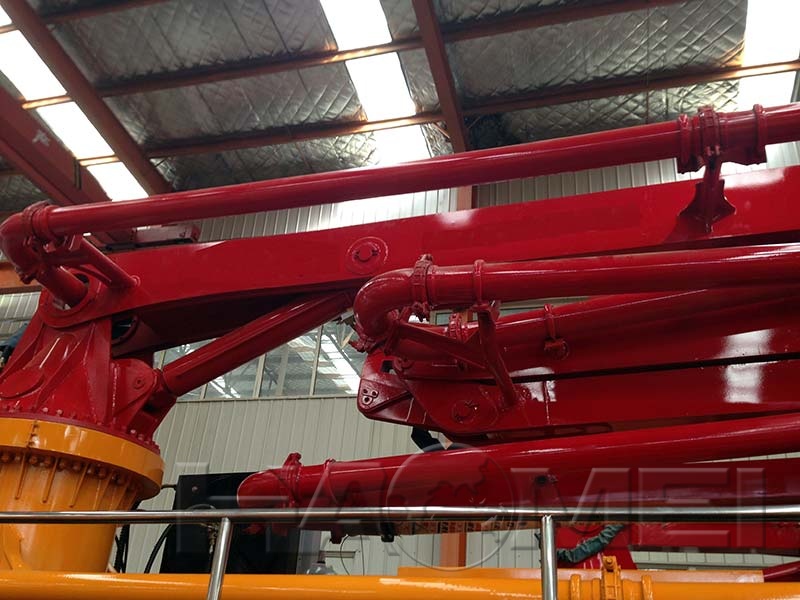
Confirm Whether a 39m-Class Pump Fits the Jobsite
Start with a placement drawing. Mark the pump parking position, slab edges, columns, crane locations, overhead lines, excavation edges, and the furthest discharge point. Then request the exact reach chart for the truck model under consideration.
A nominal 39m boom normally suits work where the truck can park close to the structure. It may be less suitable where the truck must remain outside a restricted perimeter, behind a deep excavation, or on a narrow urban street.
Use this pre-purchase checklist:
- Obtain vertical reach, horizontal reach, depth reach, and front-reach diagrams for the exact chassis and boom configuration.
- Confirm the outrigger footprint for full deployment and any manufacturer-approved partial-outrigger modes.
- Compare gross vehicle weight, axle loads, overall height, and turning radius with local road and site-access limits.
- Match pump output and concrete cylinder dimensions to planned placement rates, aggregate size, mix design, and pipeline length.
- Verify available service support, parts lead time, operator training, and inspection records.
A Boom Pump is normally selected for reach and placement speed, while a trailer pump and pipeline can be more economical for repeated high-rise pours or constrained access. The comparison should include labor, setup time, washout, pipeline handling, and lost production risk rather than purchase price alone.
| Project condition | 39m-class truck pump fit | Selection action |
|---|---|---|
| Open commercial slab | Strong fit | Check reach from planned truck position and outrigger clearance. |
| Dense city infill | Conditional | Measure street width, traffic control space, overhead utilities, and stabilizer setup area. |
| Mid-rise structure with close access | Strong fit | Verify elevation reach and boom movement around façade edges. |
| High-rise core pour | Often limited | Compare with stationary pump and climbing pipeline. |
| Long bridge deck or remote pour | Conditional | Check horizontal reach and pumping pressure requirements. |
Compare Specifications That Affect Production
Do not compare only maximum output. Manufacturers commonly publish theoretical output, while actual output depends on concrete consistency, aggregate grading, line diameter, temperature, hose routing, and operator technique. Ask suppliers to identify whether a stated output is rod-side or piston-side output and which pumping mode is used.
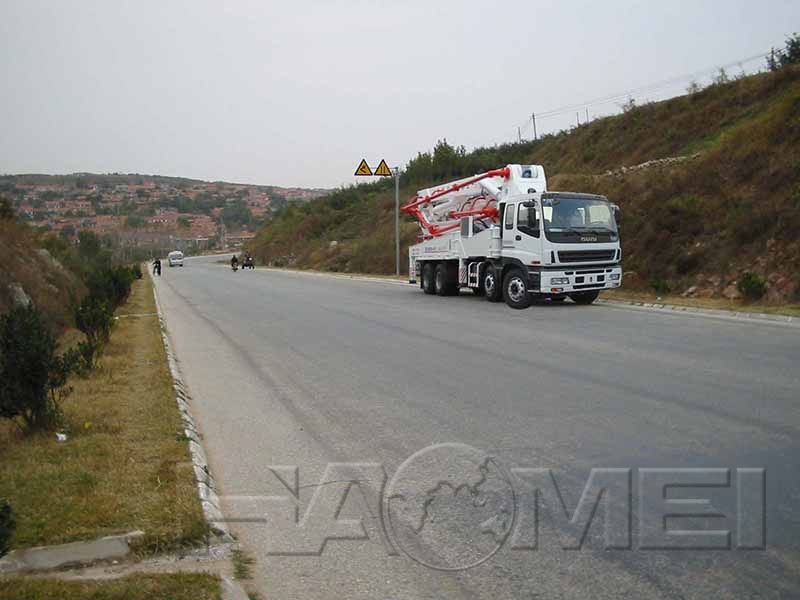
| Specification | Why it matters | What to request |
|---|---|---|
| Boom sections and articulation | Determines ability to work around columns, façades, and obstacles. | Reach diagram and boom movement envelope. |
| Pumping pressure | Important for vertical lifts, long lines, and difficult mixes. | Maximum theoretical pressure by pumping mode. |
| Concrete cylinder bore and stroke | Influences output and pressure characteristics. | Pump-unit technical sheet. |
| Hopper capacity and agitator arrangement | Affects feeding continuity and cleaning access. | Hopper drawing and wear-part list. |
| Chassis and axle configuration | Controls legal road use and access to soft or tight sites. | Axle-load sheet and transport dimensions. |
| Remote control and emergency functions | Supports placement control and emergency response. | Functional test during inspection. |
For an available configuration, compare the supplied reach chart, pump data, chassis specification, and local support package for the 39 Meter Concrete Pump Truck for Sale with competing quotations. Require all figures to be tied to a serial-numbered quotation or manufacturer datasheet.
Plan Safety, Compliance, and Operating Cost
Concrete placing booms create crush, overturning, hose-whip, line-blockage, traffic, and overhead-power-line hazards. A site-specific lift and placement plan should define truck position, exclusion zones, washout control, communication signals, emergency stop checks, and a competent person responsible for setup.
For U.S. projects, review applicable OSHA construction requirements, including Subpart O, 29 CFR 1926.600 for equipment, and electrical clearance provisions in 29 CFR 1926.416. OSHA requirements do not replace manufacturer instructions. Local rules, road permits, and utility-owner requirements may impose additional controls.
Before each shift, operators should inspect:
- Outriggers, pads, ground bearing conditions, and visible settlement.
- Boom pins, weld areas, hydraulic hoses, pipe clamps, delivery hose, and safety retaining devices.
- Emergency stops, radio remote control, hopper grate, agitator, and water system.
- Pipeline condition and correct clamp security before pressurizing.
- Exclusion zones around the end hose and any overhead electrical hazard.
ASTM C94/C94M covers ready-mixed concrete requirements. Confirm that the approved mix, aggregate size, slump or slump-flow target, admixture sequence, and discharge timing are compatible with the pump supplier's documented recommendations. Unauthorized water addition can affect concrete performance and can also increase blockage risk.
Investment and Lifecycle Checks
New and used prices vary materially by country, chassis brand, emission tier, boom configuration, options, freight, tax, and dealer support. Use comparable written quotations rather than generic online prices. For a used truck, an independent inspection can prevent expensive surprises in the boom, pump cell, hydraulic system, and chassis.
| Cost area | Evidence to collect before committing |
|---|---|
| Acquisition | Itemized quotation, warranty terms, delivery scope, taxes, and commissioning cost. |
| Wear parts | Prices and replacement intervals for spectacle plate, cutting ring, delivery pipe, elbows, clamps, and hoses. |
| Maintenance | Service history, hydraulic oil analysis where available, inspection records, and repair invoices. |
| Downtime | Local technician response time, stocked parts, and backup-machine availability. |
| Utilization | Planned annual pumping hours, job mix, travel distance, and expected billable hours. |
Industry fleet decisions increasingly use telematics for engine hours, fault alerts, maintenance scheduling, fuel use, and location control. Treat these records as operational evidence, not a substitute for physical inspection. A machine with documented maintenance, trained operators, and consistent utilization can offer a better ownership outcome than a lower-priced unit with uncertain service history.
Original source: https://www.concrete-pump-cn.com/a/39m-concrete-pump.html
Tags: 39m Concrete Pump, Concrete Pump Truck,
Previous: Concrete Mixer With Pump For Sale
Next: