

 feedom@haomei-machinery.com
Truck Mounted Concrete Pump for Sale
Posted On: 21/07/2026 | Posted by: Haomei Concrete Pumps
Current Questions About Truck Mounted Concrete Pumps
People comparing a truck mounted concrete pump for sale often focus first on boom length and quoted price. Recent English-language Q&A discussions also show strong interest in chassis compatibility, practical output, setup space, and after-sales support. The five questions below address these concerns with jobsite-focused answers for contractors considering a new concrete pump truck.
| Question Area | What to Check Before Selecting a Model |
|---|---|
| Boom reach | Vertical reach, horizontal reach, unfolding height, and placement restrictions |
| Pumping performance | Theoretical output, cylinder diameter, stroke rate, and real pipeline conditions |
| Truck chassis | Axle configuration, road legality, engine service access, and local parts availability |
| Concrete mix | Aggregate size, slump, admixtures, and ready-mix consistency |
| Ownership cost | Fuel use, wear parts, operator training, inspections, and scheduled maintenance |
1. What boom length should I choose for a truck mounted concrete pump for sale?
Boom length should be selected from the actual placement geometry, not simply from the tallest structure on the project. A 38 m boom may reach a low-rise building effectively, but it needs enough room to unfold and position outriggers safely. On restricted urban sites, a shorter boom with compact unfolding can be more productive than a longer unit that cannot be positioned near the pour area.
Measure the farthest expected discharge point from the available parking location. Then allow for hose routing, safety clearance, boom articulation, and the possibility that the truck cannot park exactly where planned. A pump with a 47 m or 56 m boom may suit larger commercial slabs and multi-story placements, while a 28 m to 37 m model can be practical for houses, small foundations, and narrow-access work.
Ask for the boom diagram rather than relying on a single reach number. The diagram shows whether the boom can work over obstacles, beneath rooflines, or through a limited opening. It also identifies the required outrigger spread, which can determine whether the machine fits the site at all.
For projects where road access is very limited but concrete still needs to travel through hose, a Mini Concrete Pump Truck may offer a more suitable balance of mobility and placing capacity.
2. Is the advertised pumping output realistic on a normal jobsite?
Not always. Manufacturers commonly state theoretical output under favorable test conditions. Actual output depends on concrete slump, aggregate grading, pipeline diameter, boom position, operator technique, hopper feeding speed, and the number of pipeline bends. A machine rated at 120 m3/h may deliver much less when pumping a stiff mix through a long line or operating near the outer boom range.
Instead of comparing output figures alone, review the complete pumping system. Larger delivery cylinders can move more concrete per stroke, while higher stroke rates may increase output but can also raise wear and fuel consumption. The main valve design, hydraulic system cooling capacity, and hopper agitation also affect consistency during long pours.
Ask the supplier for expected performance with the mix designs used in your region. If local ready-mix plants commonly supply larger aggregate or lower-slump concrete, confirm that the pump's pipeline, wear ring, cutting ring, and valve system are matched to that material. A reliable, steady placing rate is generally more valuable than a high number that cannot be sustained throughout a pour.
3. Should I select a local truck chassis or an imported chassis for a concrete pump truck?
The best chassis is usually one that can be serviced quickly where the pump will operate. A concrete pump truck combines a road vehicle with a hydraulic placing system. Even if the pump body is well engineered, downtime can increase when engine, transmission, brake, or electrical parts are difficult to obtain locally.
Before ordering, verify the chassis brand's dealer coverage, emissions compliance, axle-load limits, and registration requirements. Review the gross vehicle weight with the boom, pump body, water tank, fuel, tools, and full hopper considered. Some areas have strict limits for bridge crossing, city travel, and road permits, so axle spacing and axle count matter as much as total weight.
Also ask whether the hydraulic power take-off arrangement is supported by the chassis manufacturer. Proper integration helps prevent transmission-related issues and makes maintenance easier. For fleets operating across several regions, a commonly supported chassis can simplify operator familiarization and parts stocking.
4. How much should I budget beyond the listed price of a truck mounted concrete pump for sale?
The machine price is only part of the operating investment. Costs outside the initial quote can include shipping, import charges, commissioning, local certification, insurance, training, wear parts, and an initial inventory of pipeline accessories. A well-planned spare-parts package is especially useful because concrete-contact components wear according to mix abrasiveness and pumping hours.
Typical consumables include delivery pipes, elbows, clamps, seals, rubber hoses, piston cups, wear plates, cutting rings, filters, and hydraulic oil. Discuss recommended replacement intervals, but treat them as planning estimates rather than fixed rules. Abrasive aggregate, poor cleaning practices, and repeated high-pressure work can shorten component life.
Request a clear commercial scope that identifies what is included: remote control, pipeline length, end hose, hopper grate, water tank, tool kit, spare parts, and commissioning support. Comparing two quotations line by line is more useful than comparing their headline prices. It can reveal whether one machine includes essential jobsite equipment that the other treats as an extra.
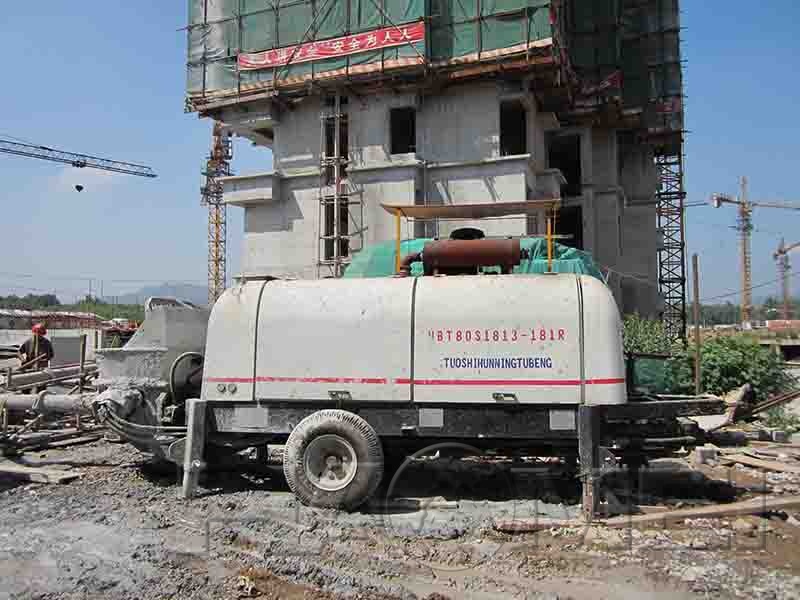
For operations that do not need a placing boom on every pour, a trailer unit such as the HBTS40 Towable Concrete Pump can reduce transport weight and initial equipment cost, though it requires separate pipeline setup and placement planning.
5. What should I inspect during factory testing and delivery acceptance?
Factory testing should demonstrate more than boom movement. Observe the complete sequence: outriggers deploying, boom unfolding, remote-control response, hopper agitation, pumping cycle, hydraulic temperature behavior, emergency stops, and automatic lubrication. If possible, request a test with concrete or a suitably representative pumping material rather than only an unloaded hydraulic demonstration.
Confirm the identification of major components, including the engine, chassis, hydraulic pumps, valve system, radio remote, and electrical control parts. Match serial numbers and specifications to the purchase agreement. Delivery documents should include operation manuals, wiring diagrams, hydraulic schematics, maintenance schedules, parts lists, warranty terms, and recommended lubricants.
During acceptance, inspect paintwork, welded boom sections, pipeline clamps, hose condition, outriggers, tires, lights, safety decals, and leakage points. Record photographs and a commissioning checklist before the machine starts regular work. Train operators to clean the hopper and pipeline immediately after each placement, monitor hydraulic oil condition, and never bypass boom or outrigger safety systems.
Original source: https://www.concrete-pump-cn.com/a/truck-mounted-concrete-pump-for-sale.html
Tags: truck mounted concrete pump for sale, concrete boom pump, concrete pump truck,
Previous: Ready Mix Pump Truck VS Small Concrete Mixer And Pump
Next: 38m Pump Truck