

 feedom@haomei-machinery.com
Truck Mounted Concrete Pump
Posted On: 05/08/2026 | Posted by: Haomei Concrete Pumps
A truck mounted concrete pump combines a placing boom, pumping system, and road-going chassis in one unit. It can reduce hose handling and accelerate slab, wall, bridge, and high-rise concrete placement, but it is not automatically the right answer for every project.
Selection should start with the pour plan, not the advertised boom length. A pump that cannot set up safely, receive ready-mix trucks efficiently, or reach the farthest placement point with adequate reserve will create delays regardless of its rated output.
Match the Pump to the Pour, Access, and Mix
Use four site measurements before requesting a quotation: farthest horizontal reach, highest vertical reach, available outrigger footprint, and truck access route. Include obstacles such as power lines, excavation edges, adjacent structures, and crane swing areas.
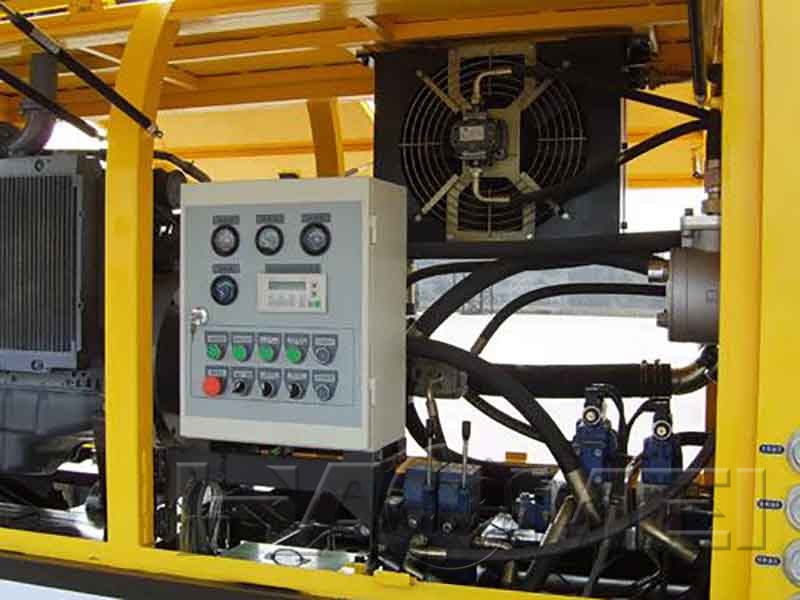
Selection checklist
Map the maximum placement point from the planned pump setup location.
Confirm the manufacturer's boom reach diagram, not only the nominal boom class.
Check setup width with outriggers fully deployed and, where permitted by the manufacturer, partially deployed.
Verify pavement, suspended slab, or ground bearing capacity under every outrigger.
Match theoretical output to the planned pour rate, while allowing for hose moves, mixer-truck changeovers, washout, and crew capacity.
Provide the concrete supplier with pumpability requirements, including aggregate size, slump or slump-flow target, admixtures, and delivery sequence.
The stated pumping output is a theoretical machine rating measured under defined conditions. Actual production falls when the mix is stiff, the pipeline is long, vertical rise is high, or the placing crew cannot accept concrete continuously. Treat rated output as a capacity ceiling, not a pour-rate promise.
| Project condition | Better equipment fit | Reason |
|---|---|---|
| Large slabs, elevated decks, wide foundations | Truck-mounted boom pump | Fast distribution across a broad work area without repeated pipeline relocation |
| Confined urban access or small residential pours | Mini Concrete Pump Truck | Smaller chassis and boom envelope can suit restricted entrances and lower-volume work |
| Long horizontal runs, tunnels, or fixed pipeline work | Line pump | Pipeline can extend where a boom cannot set up or safely operate |
| Intermittent remote work with no practical truck setup area | Trailer pump and pipeline | Lower transport complexity, although setup and line handling take longer |
Do not select a boom solely by reach. A larger boom may require a heavier chassis, larger setup area, stronger bearing surface, and more difficult transport permits. Conversely, undersizing the boom can force unsafe hose extensions or repositioning during a critical pour.
Plan Safe Setup and Productive Operation
A competent person should inspect the planned setup position before the pump arrives. The inspection must address overhead electrical hazards, underground voids or utilities, slope, edge stability, traffic control, and the travel path for concrete mixer trucks.
In the United States, OSHA requires employers to instruct employees in recognizing and avoiding unsafe conditions under 29 CFR 1926.21(b)(2). OSHA also requires appropriate personal protective equipment under 29 CFR 1926 Subpart E. For material placement systems, ASME B30.27 is a widely used industry safety standard; use the edition required by the project, local authority, insurer, or contract.
Pre-pour safety controls
| Hazard | Required control before pumping starts |
|---|---|
| Overhead power lines | Identify voltage and clearance requirements, establish a restricted zone, and follow the utility owner's and applicable regulatory procedures |
| Outrigger settlement | Assess bearing capacity, use manufacturer-approved pads or mats, level the unit, and recheck during the pour |
| Hose whip and line blockage | Secure the end hose, keep personnel out of the discharge hazard area, and follow the manufacturer's depressurization procedure before opening any line |
| Reversing mixer trucks | Establish a traffic plan, designated signaler, exclusion zone, and clear communication method |
| Boom movement near people | Maintain an exclusion area beneath the boom and prevent workers from riding hoses, pipelines, or the boom |
| Concrete exposure | Supply alkali-resistant gloves, eye and face protection, waterproof footwear, wash water, and immediate skin-cleaning provisions |
The operator should conduct the daily inspection specified in the operation manual. Typical checks include hydraulic oil level and leaks, hopper grate condition, emergency stops, boom function, pipeline clamps, outriggers, remote control operation, tires, lights, and chassis alarms. Record faults and remove the machine from service when a safety-critical defect is found.
Washout planning deserves the same attention as setup. Concrete wash water is alkaline and may contain solids. Use a contained washout area and follow the project stormwater plan and local environmental requirements. Never discharge washout to a storm drain, watercourse, or unprotected soil.
Evaluate Ownership Cost, Compliance, and Digital Features
Purchase price is only one element of investment planning. Obtain comparable written quotations with the same chassis specification, boom length, pump cell output, remote-control package, emissions configuration, warranty, commissioning, training, spare parts, and delivery terms. A lower initial quotation may omit essential support or have a limited service network.
Calculate annual ownership cost using this structure:
Annual ownership cost = finance or depreciation + insurance + registration + inspections + preventive maintenance + wear parts + fuel or energy + operator training + downtime allowance
Wear items deserve line-by-line review. Depending on design and operating conditions, these can include wear plates, cutting rings, delivery cylinders, piston cups, agitator components, hopper parts, pipeline elbows, clamps, and end hoses. Abrasive aggregate, high pumping pressure, poor cleaning practices, and frequent pumping of harsh mixes increase replacement frequency.
Ask the supplier for documented service intervals, parts lead times, local technician coverage, and warranty exclusions. Also request data on the chassis engine emissions label. In the U.S., new nonroad diesel engines are subject to EPA emission standards, while on-road truck chassis are regulated under separate EPA highway engine rules. Requirements vary by jurisdiction, so confirm fleet registration, idling, noise, and local clean-air restrictions before committing to a configuration.
Telematics is becoming practical for concrete placement fleets. Useful data includes engine hours, hydraulic pressure trends, fault codes, GPS location, fuel use, idle time, maintenance alerts, and pump-cycle counts. Ask whether the system provides data ownership terms, export capability, user permissions, cellular coverage requirements, and integration options. A dashboard is valuable only when dispatch, maintenance, and site teams use its alerts to prevent missed service and unplanned downtime.
Supplier comparison questions
What is the verified boom reach diagram and full-outrigger footprint for this exact model?
Which concrete mix limits, aggregate sizes, and line diameters are approved in the operating manual?
What are the scheduled replacement intervals and current prices for common wear parts?
Is commissioning and operator familiarization included at delivery?
Where is the nearest authorized service location, and what is its stated response process?
Which safety devices are standard, and which are optional?
Can the supplier provide machine records, inspection documentation, and pump-hour history for a used unit?
What residual-value assumptions, financing terms, and planned annual utilization support the investment case?
Original source: https://www.concrete-pump-cn.com/a/truck-mounted-concrete-pump-2026-08-05.html
Tags: Truck Mounted Concrete Pump, Concrete Pump Truck,
Previous: 38m Pump Truck
Next: Tow Behind Concrete Pump